Systems
AeonCore develops specialised systems for different classes of complex problems.
The systems currently visible publicly represent only part of a wider research architecture. Each domain evolves independently, with its own identity, technologies and objectives, while remaining connected through the AeonCore Framework.
AEONCORE SYSTEMS
Different domains. Shared foundations.
AeonCore systems apply a common research philosophy to very different areas of investigation.
Some are scientific. Some are environmental. Some are operational platforms. Others are still developing from research into real-world systems.
Their technologies and public identities may differ, but they remain connected through shared principles of evidence, modelling, context and responsible intelligence.
Some are scientific. Some are environmental. Some are operational platforms. Others are still developing from research into real-world systems.
Their technologies and public identities may differ, but they remain connected through shared principles of evidence, modelling, context and responsible intelligence.
One ecosystem.
Multiple specialised systems.
How the Family Works
A family, not a product suite
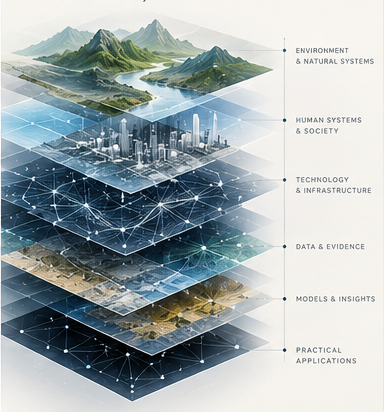
AeonCore systems are not intended to be interchangeable products carrying the same interface and branding.
Each domain develops according to the needs of the field it serves.
Xenovium must behave like a scientific research environment. Agrista must work within agriculture. AeonCore-E must understand learning and human capability. Gaia must operate within environmental and planetary systems.
Their connection to AeonCore is architectural and intellectual rather than cosmetic.
Each domain develops according to the needs of the field it serves.
Xenovium must behave like a scientific research environment. Agrista must work within agriculture. AeonCore-E must understand learning and human capability. Gaia must operate within environmental and planetary systems.
Their connection to AeonCore is architectural and intellectual rather than cosmetic.
Shared origin does not require identical expression.
Current Public Domains
The following domains currently represent the public face of AeonCore's expanding research ecosystem.
Science & Discovery
AeonCore-X is the scientific research domain of AeonCore.
It supports computational exploration of questions at the edges of established scientific understanding, particularly where theoretical models, large search spaces or unconventional hypotheses require new ways of investigation.
It supports computational exploration of questions at the edges of established scientific understanding, particularly where theoretical models, large search spaces or unconventional hypotheses require new ways of investigation.
Planetary & Environmental Systems
AeonCore-G focuses on complex environmental and planetary systems, including resilience, regeneration and relationships between human activity and natural environments.
Its purpose is to support better understanding of how environmental systems respond to change and how interventions may create wider consequences.
Its purpose is to support better understanding of how environmental systems respond to change and how interventions may create wider consequences.
Agriculture & Food Systems
AeonCore-A applies intelligent systems to agriculture, food production, land management, traceability and regenerative practices.
It explores how environmental context, agricultural activity, evidence and long-term sustainability can be connected within operational decision-support systems.
It explores how environmental context, agricultural activity, evidence and long-term sustainability can be connected within operational decision-support systems.
Education & Human Capability
AeonCore-E is the educational domain of AeonCore.
It is being developed to connect learning resources, knowledge, skills, learner needs, assessment, evidence and demonstrated capability within a unified educational intelligence ecosystem.
It is being developed to connect learning resources, knowledge, skills, learner needs, assessment, evidence and demonstrated capability within a unified educational intelligence ecosystem.
Associated initiative
Status
In development
In development
Xenovium
Exploring the boundaries of scientific possibility
Xenovium is a scientific research initiative built within AeonCore-X.
It explores theoretical and computational questions that sit beyond the practical reach of conventional experimentation, with particular interest in atomic structure, extreme nuclear stability and the possible behaviour of superheavy elements.
Rather than treating computational output as proof, Xenovium uses modelling as a tool for investigation: a way to explore hypotheses, identify interesting regions of possibility and generate questions that can be examined more rigorously.
It explores theoretical and computational questions that sit beyond the practical reach of conventional experimentation, with particular interest in atomic structure, extreme nuclear stability and the possible behaviour of superheavy elements.
Rather than treating computational output as proof, Xenovium uses modelling as a tool for investigation: a way to explore hypotheses, identify interesting regions of possibility and generate questions that can be examined more rigorously.
Computation as a laboratory for questions that cannot yet be tested physically.
Z164
A focused scientific investigation
Z164 is a specialised research programme associated with AeonCore-X and Xenovium.
It investigates the theoretical possibility and behaviour of an element with atomic number 164, including questions of stability, structure and the physical conditions under which such matter might exist.
Z164 represents the way AeonCore research can move from broad computational exploration toward increasingly focused scientific questions.
It investigates the theoretical possibility and behaviour of an element with atomic number 164, including questions of stability, structure and the physical conditions under which such matter might exist.
Z164 represents the way AeonCore research can move from broad computational exploration toward increasingly focused scientific questions.
From a large space of possibilities to a specific research question.
Gaia Protocol
Understanding environmental systems as connected systems
Gaia is the principal initiative currently associated with AeonCore-G.
It explores environmental intelligence through the relationships between ecosystems, human activity, resources, resilience, regeneration and long-term change.
Gaia is designed around the recognition that environmental challenges cannot be understood through isolated indicators alone. Decisions affecting energy, land, communities, infrastructure or natural systems may create consequences far beyond their immediate objective.
It explores environmental intelligence through the relationships between ecosystems, human activity, resources, resilience, regeneration and long-term change.
Gaia is designed around the recognition that environmental challenges cannot be understood through isolated indicators alone. Decisions affecting energy, land, communities, infrastructure or natural systems may create consequences far beyond their immediate objective.
Environmental intelligence begins with understanding relationships.
Agrista
Intelligence for agriculture and regenerative food systems
Agrista is the principal operational initiative within AeonCore-A.
It brings together agricultural activity, environmental context, evidence, traceability and decision support to help build a more complete understanding of how food and land systems operate.
Agrista is intended to support both practical agricultural decisions and the longer-term transition toward systems capable of demonstrating environmental and regenerative outcomes.
It brings together agricultural activity, environmental context, evidence, traceability and decision support to help build a more complete understanding of how food and land systems operate.
Agrista is intended to support both practical agricultural decisions and the longer-term transition toward systems capable of demonstrating environmental and regenerative outcomes.
From agricultural activity to measurable understanding.
AeonCore-E
Education built around capability
AeonCore-E is being developed as the educational intelligence domain of AeonCore.
It begins from the idea that education is more than delivering content and recording course completion.
Learning involves existing knowledge, individual needs, resources, teaching, assessment, feedback, skills, evidence and demonstrated capability. AeonCore-E aims to connect these elements so that education can become more adaptive, meaningful and measurable.
Its long-term role extends beyond that of a conventional learning management system.
AeonCore-E is intended to support the complete learning journey: understanding what a learner needs, identifying appropriate pathways, supporting learning, assessing achievement and connecting demonstrated outcomes to meaningful evidence of capability.
It begins from the idea that education is more than delivering content and recording course completion.
Learning involves existing knowledge, individual needs, resources, teaching, assessment, feedback, skills, evidence and demonstrated capability. AeonCore-E aims to connect these elements so that education can become more adaptive, meaningful and measurable.
Its long-term role extends beyond that of a conventional learning management system.
AeonCore-E is intended to support the complete learning journey: understanding what a learner needs, identifying appropriate pathways, supporting learning, assessing achievement and connecting demonstrated outcomes to meaningful evidence of capability.
The objective is not simply to complete learning. It is to develop capability that can be demonstrated.
Different Stages of Maturity
Research does not always become a product
AeonCore systems can exist at different stages of maturity.
Research
Some initiatives exist primarily to investigate hypotheses, models and new questions.
Experimental Systems
Promising ideas may become prototypes or experimental environments where concepts can be tested.
Operational Platforms
Mature research can develop into systems used within real organisations, communities or professional environments.
Reasoning
Movement between these stages depends on evidence and usefulness, not simply on a desire to commercialise every idea.
One System May Inform Another
Knowledge can travel between domains
AeonCore domains remain distinct, but they do not exist in intellectual isolation.
Research developed in one area may reveal methods, models or questions relevant elsewhere.
Environmental intelligence can inform agriculture. Education can support the development of professional capability required by emerging technologies. Scientific methods can influence modelling approaches used far beyond their original discipline.
The purpose is not to merge every domain into one system.
It is to allow useful ideas to cross boundaries when the evidence justifies it.
Research developed in one area may reveal methods, models or questions relevant elsewhere.
Environmental intelligence can inform agriculture. Education can support the development of professional capability required by emerging technologies. Scientific methods can influence modelling approaches used far beyond their original discipline.
The purpose is not to merge every domain into one system.
It is to allow useful ideas to cross boundaries when the evidence justifies it.
Separate systems.
Connected learning.
More Than Four
An expanding architecture
The systems presented here are not intended to define the permanent boundaries of AeonCore.
Additional domains already exist at different stages of conceptual and research development, and new areas may emerge as the ecosystem evolves.
AeonCore domains are introduced publicly when there is sufficient substance behind them — not simply because a name or concept exists.
Additional domains already exist at different stages of conceptual and research development, and new areas may emerge as the ecosystem evolves.
AeonCore domains are introduced publicly when there is sufficient substance behind them — not simply because a name or concept exists.
The family grows when the work is ready.
How New Domains Emerge
From question to domain
Question
A recurring problem or research area emerges that cannot be adequately addressed within an existing domain.
Research
The problem develops into a substantial body of investigation, models and concepts.
Architecture
A coherent system begins to form around the research.
Domain
The area becomes mature enough to operate as a distinct AeonCore domain or initiative.
Not every research idea needs its own AeonCore letter.
Specialised systems for interconnected questions
AeonCore allows different domains to develop the depth and independence they require while remaining connected to a common research foundation.
As the ecosystem grows, the systems may become increasingly diverse.
The principle connecting them remains the same: understand the system, respect the evidence, explore the relationships and build technology that contributes practical value.
As the ecosystem grows, the systems may become increasingly diverse.
The principle connecting them remains the same: understand the system, respect the evidence, explore the relationships and build technology that contributes practical value.